Imagine being right in the heart of the wilderness with a Tanzania Camping Safari that brings an unforgettable up-close and personal experience of the African bush. Kongoni Adventures is devoted to promoting three types of Camping Safaris; Budget Camping for the adventure traveler, Standard Camping for those seeking some degree of comfort, and Luxury Camping for the best camping experience one can have. By and large, all of our programmes are custom designed to fit the requirements of our customers.
A Typical Day on a Tanzania Camping Safari
At the break of dawn, the shifting colors of the morning sun luminate the acacia landscape. The savannah is bright red, then orange and finally settling to a golden hue as the grassland comes to life. You begin your day by taking a short walk just to awaken your spirit.
Upon your return, a full English breakfast is served in the open under a morning breeze. Soon, you embark on a morning game drive, where you are treated to the rich tapestry of habitats teeming with wildlife and exotic birds.
You return to the campsite at midday for lunch under the shade of a Baobab tree. A tasty meal with fresh vegetable and tropical fruit is served. After, a siesta is as welcoming as a gaze over the seemingly endless plains sprawling for miles on end.
Soon, it will be time for an exciting afternoon game drive. The game viewing is abundant with lions, hippos, rhinos, cheetahs, buffaloes and giraffes just beyond your wondering eyes. Under the dazzling colors of sunset, you return to the campsite where your take a warm shower and wait for another adventure.
Your safari cook anxiously awaits your arrival at the dinner table immaculately set next to a crackling campfire underneath the brilliant canopy of stars. While you dine on a five-course safari cuisine, gazelles make their way to a favorite watering hole while curious baboons sniff the aroma of the rich Tanzanian coffee in your cup.
After dinner, an evening of stories and tails is shared by the flickering campfire as relationships cement and memories forged forever in the African wilderness. As night falls, you head to your tent for a well deserved rest.
While you drift off to sleep under the canvas tent, you hear lions roar and a hyena’s mating call in the distance. It’s nothing to be startled about, as a ranger stands guard throughout the night. As the whispering wind blows, tenderly brushing the tents you are gently lured into a deep sleep.
The midnight coolness punctuated with the occasional echo ushers in the wee hours of morning. After a peaceful night, the terrain begins to slowly come to life again, as you awaken for a new day of discovery.
Conclusion
There’s no better way than Camping in Tanzania to experience the true essence of the African wilderness. If you befit a person who respects nature and wants to experience the African bush in its unique environment, please contact us to arrange a tailor-made adventure for you.
Showing posts with label Kongoni Adventures.. Show all posts
Wednesday, April 11, 2012
Saturday, March 24, 2012
African Derter
Behaviour
This species builds a stick nest in a tree and lays 3-6 eggs. It often nests with herons, egrets and cormorants.It often swims with only the neck above water, hence the common name snakebird. This too is a habit shared with the other anhingas.
Unlike many other waterbirds the feathers of the African Darter do not contain any oil and are therefore not waterproof. Because of this, the bird is less positively buoyant and its diving capabilities are enhanced. After diving for fish, the feathers can become waterlogged. In order to be able to fly and maintain heat insulation it needs to dry its feathers. Thus the African Darter is often seen sitting along the waterside spreading its wings and drying its feathers in the wind and the sun along with cormorants which may share its habitat.
Tuesday, March 20, 2012
Acacia Pied Barbert.
Ecology
Like most other barbets, the Acacia Pied Barbet drills holes into dead wood in order to create cavity nests, similar in manner to a woodpecker. It lays two to four eggs from August to April, and both sexes incubate the eggs.The Acacia Pied Barbet has been observed taking fruit from various trees and shrubs, such as Ficus, Rhus and Phoenix reclinata, as well as Aloe nectar and insects.
Impala.
Ecology
Impalas are adaptable foragers. They usually switch between grazing and browsing depending on the season. During wet seasons when grasses are green and growing they graze. During dry seasons it browses foliage, shoots, forbs and seeds. It can also adapt to different habitats by being a grazer in one habitat a browser in another. Leopards, cheetahs, lions and wild dogs prey on impala.
Impala, as well as other small- to medium-sized African antelopes, have a special dental arrangement on the front lower jaw similar to the toothcomb seen in strepsirrhine primates, which is used during grooming to comb the fur and remove ectoparasites.
Kirk's Dik Dik.
Kirk's Dik Dik Genetic and behavioural evidence suggests that Kirk's Dik-dik exhibits fidelity in monogamous behaviour. Genetic analysis of off-spring indicate little non-pair parentage. Year-round, Kirk's Dik-diks stay close within pairs, follow each other's activity patterns and spend more than half of their time with their partners, although males give no parental care. The males guard their mates closely during oestrus and over-mark all female scent. This behaviour reduces the likelihood of other males attempting to mate, however, males do attempt to mate with other females on occasion. Genetic monogamy in dik-diks is probably best explained by the behaviour of females: in contrast to many monogamous female birds, female dik-diks do not appear to seek to mate outside the pair-bond.
Friday, March 16, 2012
Baboons and Monkeys
Behavior
Baboons are terrestrial (ground dwelling) and are found in open savannah, open woodland and hills across Africa. Their diet is omnivorous, but mostly herbivorous; yet they eat insects and occasionally prey on fish, shellfish, hares, birds, vervet monkeys, and small antelopes. They are foragers and are active at irregular times throughout the day and night. They can raid human dwellings and in South Africa they have been known to prey on sheep and goats.Their principal predators are humans, the lion, both the spotted and striped hyena and the leopard. They are however considered a difficult prey for the leopard, which is mostly a threat to young baboons. Large males will often confront them by flashing their eyelids, showing their teeth by yawning, making gestures, and chasing after the intruder/predator.
Baboons in captivity have been known to live up to 45 years, while in the wild their life expectancy is about Baboons.
Behaviour
Social structure
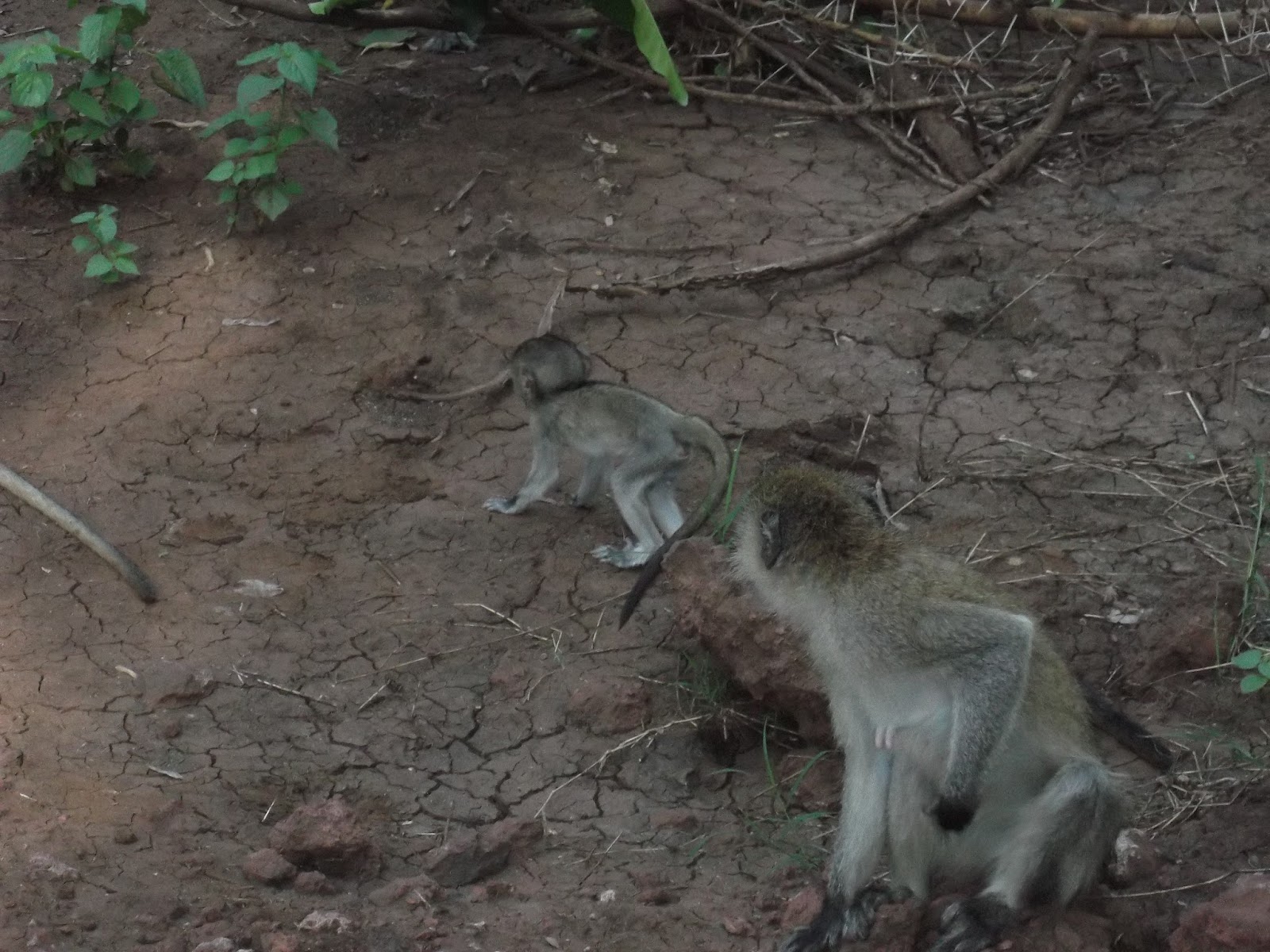
The vervet monkey is diurnal and social; living in groups of up to 72. There is a clear order of dominance among individuals within the group.Alarm calls
The vervet monkey uses different calls upon detecting different types of predators, including leopards, snakes and eagles. Infants appear to have an innate tendency to make these alarm calls, and adult monkeys seem to give positive reinforcement when their young make the right call, by repeating the alarm. Mothers have been reported to punish young giving the wrong call
4X4 From Kongoni Adventures
4X4 is considered to be any type ofvehicle which is capable of driving on and off paved or gravel surface. It is generally characterized by having large tires with deep, open treads, a flexible suspension. 
Thursday, March 15, 2012
SERENGETI NATIONAL PARK..
The spectacle of predator versus prey dominates Tanzania’s greatest park. Golden-maned lion prides feast on the abundance of plain grazers. Solitary leopards haunt the acacia trees lining the Seronera River, while a high density of cheetahs prowls the southeastern plains. Almost uniquely, all three African jackal species occur here, alongside the spotted hyena and a host of more elusive small predators, ranging from the insectivorous aardwolf to the beautiful serval cat.
Subscribe to:
Posts (Atom)